From the StoryNest reading nook
Talking while you read: the questions that build vocabulary and comprehension at story time
Already reading aloud daily? Here's what to say and when to pause so story time builds your child's vocabulary and comprehension, ages 2 to 8.
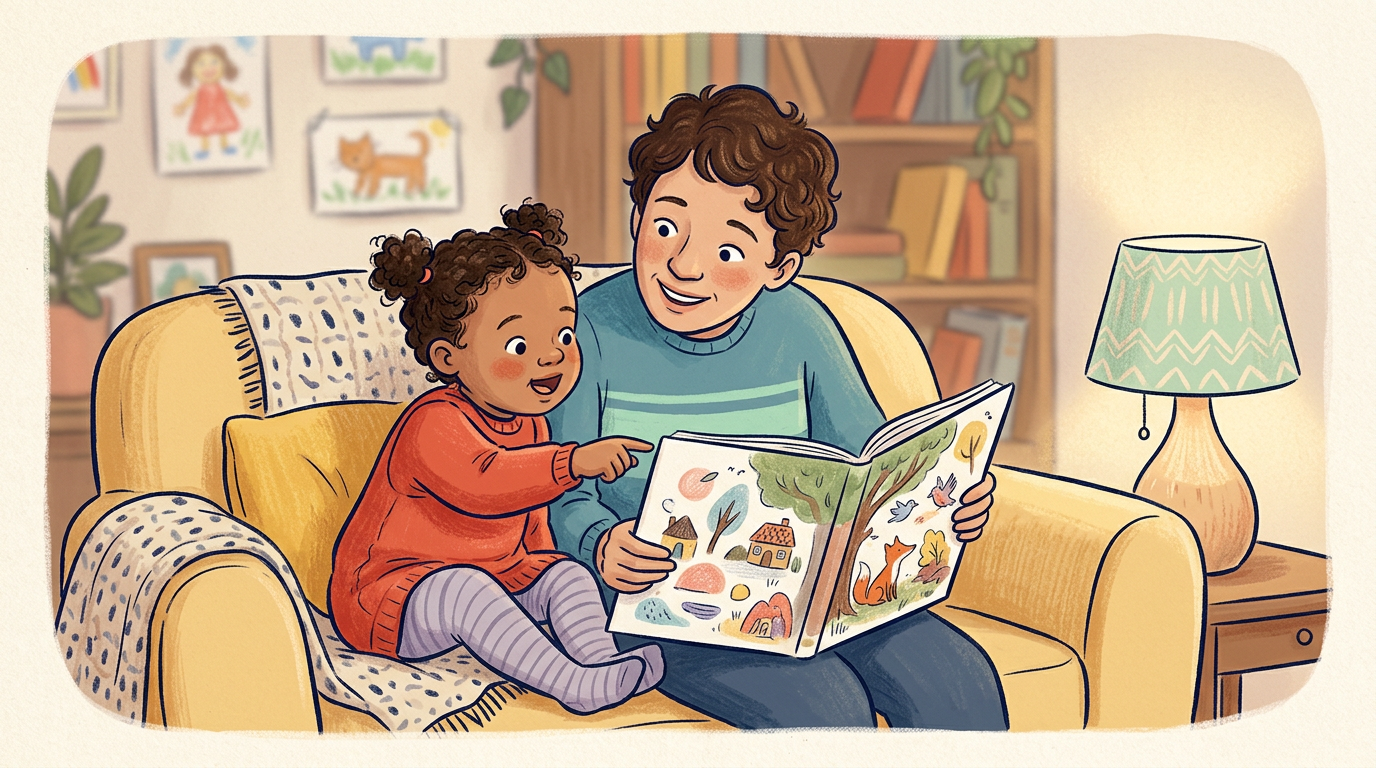
If you're already reading aloud every day, a bit of talk in the right places makes a real difference to how much your child gets out of it. Not quizzing, and not narrating every page like a comprehension test. Just a handful of well-placed comments and questions that turn a shared book into a two-way conversation.
You don't need a script, a workbook or special training. There's a well-researched way of structuring this talk, called dialogic reading, and it maps closely onto advice Australian parents already trust. Below is what the research shows, what it doesn't promise, and what to say at bedtime or in the classroom, broken down by age.
TL;DR
- Talking about a book while you read it builds oral language and comprehension, a skill separate from decoding words on the page but just as important for reading success.
- The most studied technique is dialogic reading, summarised by two acronyms: PEER (Prompt, Evaluate, Expand, Repeat) and CROWD (Completion, Recall, Open-ended, Wh-, Distancing) prompts.
- Raising Children Network already recommends CROWD-style questions for Australian families. This isn't an overseas import; it's close to what trusted local guidance already says.
- Effects are real but moderate: expect improved vocabulary and listening comprehension, not faster decoding or fluency.
- Follow your child's lead. Some children want to talk; others want to listen quietly or turn the pages themselves. Both are fine.
- Age matters: simple completion and recall prompts suit toddlers, while open-ended, wh- and distancing prompts suit school-age children.
Why talking about the book matters
Reading comprehension depends on two things: being able to recognise the words, and being able to understand language itself. This is often called the Simple View of Reading, and it underpins how reading instruction in Australia is understood. The Australian Education Research Organisation (AERO) describes reading comprehension as "a product of word identification ability and language comprehension."
Word identification, sounding out letters, blending, recognising words on sight, is what phonics instruction and decoding practice build. The other half, language comprehension, is "the ability to derive meaning from spoken and written words," and AERO notes that oral language has increasingly been recognised as "a foundation for reading success."
That means the conversation you have around a book is doing real work on the comprehension side of reading, independent of whether your child can read a single word yet. A toddler who can't decode anything can still build the vocabulary and listening-comprehension skills that will make reading make sense to them later.
The technique: dialogic reading, PEER and CROWD
The most researched way to structure this in-the-moment talk comes from psychologist Grover Whitehurst's original dialogic reading research. It's built around two acronyms.
PEER describes the rhythm of each exchange:
- Prompt the child to say something about the book
- Evaluate their response
- Expand on what they said, adding a bit more
- Repeat the prompt to help them consolidate the expanded idea
CROWD describes the types of prompts you can use, generally moving from simpler to more demanding:
- Completion: leave a gap in a sentence for the child to fill in
- Recall: ask what happened earlier in the book
- Open-ended: invite description, often of a picture
- Wh- questions: who, what, where, why, when
- Distancing: connect the story to the child's own life and experience
A typical exchange might look like this: you pause mid-sentence ("The kangaroo hopped all the way to the…"), your child fills the gap, you say "That's right, the dam!", then expand ("The big dam near the paddock"), then repeat the fuller sentence back so they hear the complete idea again.
It's already in Australian parenting advice
This approach isn't a research trend arriving from overseas with no local backing. Raising Children Network, Australia's government-backed parenting authority, already recommends near-identical practice, just without the acronyms.
For babies, it suggests moving beyond just reading the printed words: "point out, name and talk about things your baby sees on the page, instead of only reading the words, for example, 'That's a bunny. Look. The bunny is hopping away.'" That's essentially an open-ended prompt, scaled right down for the youngest listeners.
For preschoolers, Raising Children recommends asking questions about the story such as "What do you think happens next?", "Why is the baby happy?" or "Who has the ball?" These are wh- and open-ended prompts in everyday Australian parenting language.
If you've ever pointed at a picture and named it for your baby, or asked your four-year-old why a character is hiding, you've already been doing dialogic reading. This article gives it some structure and extends it into the primary years, where a lot of existing guidance tends to stop.
What the evidence shows, and doesn't
It's worth being honest about effect sizes here, because overpromising helps nobody.
A 2022 systematic review of the dialogic reading literature found it "can have positive effects on enjoyment of reading, reading motivation, parental, child attachment, parental confidence and stress," which are useful outcomes, especially for families who find story time stressful. But the same review was upfront that "the extant research is subject to limitations, and more methodologically robust research is needed" (Pillinger, 2022, via Reach Out and Read). This isn't a technique with decades of gold-standard trials behind it. It's promising, not proven beyond doubt.
A more recent classroom trial in Uganda gives a useful sense of scale: children taught with dialogic reading scored higher on vocabulary and listening comprehension than those taught with usual instruction, with a vocabulary difference of "3.2 points on a 20-point scale (16% of the scale range)." That's a genuine, moderate improvement, not a dramatic leap, and worth having but not a substitute for other foundations of literacy.
Broader research on classroom read-alouds backs up that how you read matters as much as what you read, and that vocabulary needs to be explicitly unpacked, not just heard in passing: "instructors need to, in addition to reading aloud, explain the vocabulary and its contextual meaning in the text in order to effectively promote children's vocabulary acquisition."
Dialogic reading targets vocabulary and listening comprehension. It is not a substitute for systematic phonics instruction, structured decoding practice, or speech pathology support where a child has a persistent language difficulty. If your child continues to struggle with understanding spoken language, following stories, or building vocabulary despite regular, supportive reading together, it's worth mentioning this to their teacher, or speaking with a speech pathologist or GP.
Age by age: what to actually say
Rigid CROWD prompts applied uniformly to every age group don't work well. A three-year-old doesn't need a distancing question about empathy, and an eight-year-old doesn't need every sentence interrupted for a completion prompt. Here's how to calibrate it.
Ages 2 to 3: naming, completion and simple recall
At this age, keep it light and mostly non-verbal-friendly. Point and name things on the page rather than only reading text. Use completion prompts on familiar, repetitive books ("Brown bear, brown bear, what do you…"). Ask one simple recall question per book, if at all ("Where did the dog go?"). Don't worry if your toddler answers with a single word, a point, or nothing at all; the exposure and the modelling are still doing work.
Ages 4 to 5: open-ended and wh- questions
Preschoolers can handle more. Ask "What's happening in this picture?" before reading the words on a busy page. Follow up with why and how questions: "Why do you think she's hiding?" "How did the wombat get out of the hole?" This is the sweet spot Raising Children's preschool guidance describes, and it's where most of the CROWD framework comfortably sits for this age group.
Ages 6 to 8: distancing, inference and vocabulary in context
School-age children who are reading independently, listening to a chapter book, or being read to can handle distancing prompts that connect the story to their own life: "Have you ever felt scared like that at the pool?" This is also the age to start naming tricky or interesting words in context rather than skipping past them, for example "Starving doesn't just mean a bit hungry, it means desperately hungry, like she hasn't eaten in days." Briefly defining two or three unfamiliar words per book, in plain language, mirrors what effective classroom read-alouds do.
A worked bedtime example
Here's how one short picture-book session might flow, using an Australian story about a kangaroo and a wombat:
| Prompt type | What you say | What it does |
|---|---|---|
| Completion | "The kangaroo hopped all the way to the…" (pause) | Invites a one-word fill-in using context and memory |
| Recall | "What did the wombat do first, before the kangaroo arrived?" | Checks and reinforces sequence and memory |
| Open-ended | "What's happening in this picture?" | Builds descriptive language, with no "right" answer pressure |
| Wh- | "Why do you think she's hiding behind the rock?" | Encourages inference, not just literal recall |
| Distancing | "Have you ever felt scared like that, like at the pool?" | Connects story to lived experience and personal vocabulary |
You don't need to hit every category every time. Even one or two of these per book is enough to shift story time from passive listening to active conversation.
When not to stop and ask anything at all
The goal is dialogue, not interrogation, and the research itself supports backing off when a child isn't in the mood for it.
Raising Children's own guidance is to let the child lead: "let your child choose how to read, do they want to talk about the story and pictures? Listen quietly while you read? Or turn the pages and tell the story themselves?" All three are legitimate ways to enjoy a book.
If your child sighs, pulls the book back towards themselves, or says "just read it," that's useful information, not a failure on your part. Some of the richest nights of story time are the ones where nobody says a word except the narrator. Save the questions for when your child seems curious, chatty, or genuinely puzzled by something on the page, and ease off when they clearly want to just listen.
For teachers: connecting this to the classroom
For educators, this kind of talk connects directly to what the Australian Curriculum (v9.0) asks of students. By the end of Foundation, students are expected to "listen to texts, interact with others and create short spoken texts, including retelling stories." By Year 3, the expectation moves to using "comprehension strategies when listening and viewing to build literal and inferred meaning," which is exactly the territory that recall, wh- and inference-building prompts target.
A practical classroom version of dialogic reading: before reading aloud, pre-select two or three tier-two vocabulary words (words like "enormous," "reluctant" or "glanced" rather than subject-specific jargon) and briefly define them in context as you reach them, alongside questions that get students thinking about the text. The structure scales from one-on-one bedtime reading to a class of twenty-five.
If you're building this into a classroom routine, StoryNest's resources for schools include further material on structuring shared reading time around vocabulary and comprehension goals.
Questions parents and teachers ask
Am I "doing it wrong" if I just read without stopping?
No. Reading straight through without pausing is a completely valid way to enjoy a book together, especially if your child prefers to listen quietly or is tired at bedtime. Raising Children Network frames this as a choice for the child to make, not a rule to follow. Dialogic reading is a tool to use when it fits, not an obligation for every page of every book.
My child gets annoyed when I stop to ask questions, what then?
Back off and try again another time, or with a different book. Irritation is a sign the dialogue isn't landing in that moment; it doesn't mean the technique has failed or that you need to push through it. Try reading the whole book uninterrupted first, then coming back to a page they loved and asking one open-ended question about the picture, rather than stopping throughout.
Does this work the same way with audiobooks or a recorded read-aloud from a FIFO parent?
Partially. A recorded or audio read-aloud can still build vocabulary through the words and expression a child hears, but it can't pause and respond to what your child actually says back; the "evaluate and expand" part of PEER needs a live listener. If you use audiobooks or a recorded voice while a parent is away, you can still get some of the benefit by pausing the recording yourself and asking a quick question, or talking about the book together afterwards.
What's the difference between this and "quizzing" my child on a book?
Quizzing tends to focus on one correct, literal answer and can feel like a test, for example "What colour was the dog?" Dialogic reading focuses more on open-ended thinking, inference and connecting the story to the child's own experiences, with no single right answer expected. The "evaluate and expand" step matters most here: you're building on what the child says rather than simply marking it right or wrong.
Is this useful for kids who already read independently, or just pre-readers?
It's useful at both ends, just in different forms. For independent readers aged 6 to 8, the conversation shifts towards inference, vocabulary in context, and distancing questions that link the story to real life. These stay useful even once decoding is well established, because listening comprehension and vocabulary keep developing well beyond the point a child can read fluently.
How is this different from what my child's teacher does at school?
It's the same underlying idea, scaled differently. Teachers use structured read-alouds with pre-selected vocabulary and comprehension questions tied to curriculum outcomes, often with a whole class. At home, it's far more informal and led by your child's interest on any given night. Both are building the same skills, vocabulary and listening comprehension, from different angles.
Where this fits with everything else you're already doing
This kind of in-the-moment talk sits underneath a lot of other reading advice, rather than replacing any of it. It works alongside helping a child who's stuck on a word while decoding, choosing engaging books in the first place, or building daily reading motivation. If your family is juggling audiobooks, recorded read-alouds from an absent parent, or repeated reading for fluency practice, the conversational techniques here can be layered on top of any of those formats where a live listener is present.
You can browse more reading-related guidance on the StoryNest resources hub, or explore StoryNest itself if you're looking for stories built with this kind of shared reading in mind. Families wanting to try a more structured approach can also create a free account to get started.
Sources
- Australian Education Research Organisation (AERO), Introduction to the Science of Reading
- Raising Children Network, Reading and storytelling with babies and children: benefits and tips
- Raising Children Network, Let's Read: reading & literacy tips
- Pillinger, C. (2022), The story so far: A systematic review of the dialogic reading literature
- Effects of dialogic reading with Luganda primary 1 materials, Springer, 2026
- Reading Rockets, Dialogic Reading: Having a Conversation about Books
Keep the next story going.
All resources