From the StoryNest reading nook
When you can't be there for bedtime: making a recorded read-aloud for your child
FIFO work, defence postings, shared custody or a hospital stay can keep you from bedtime. Here's how to make a recorded read-aloud that helps, and stays legal.
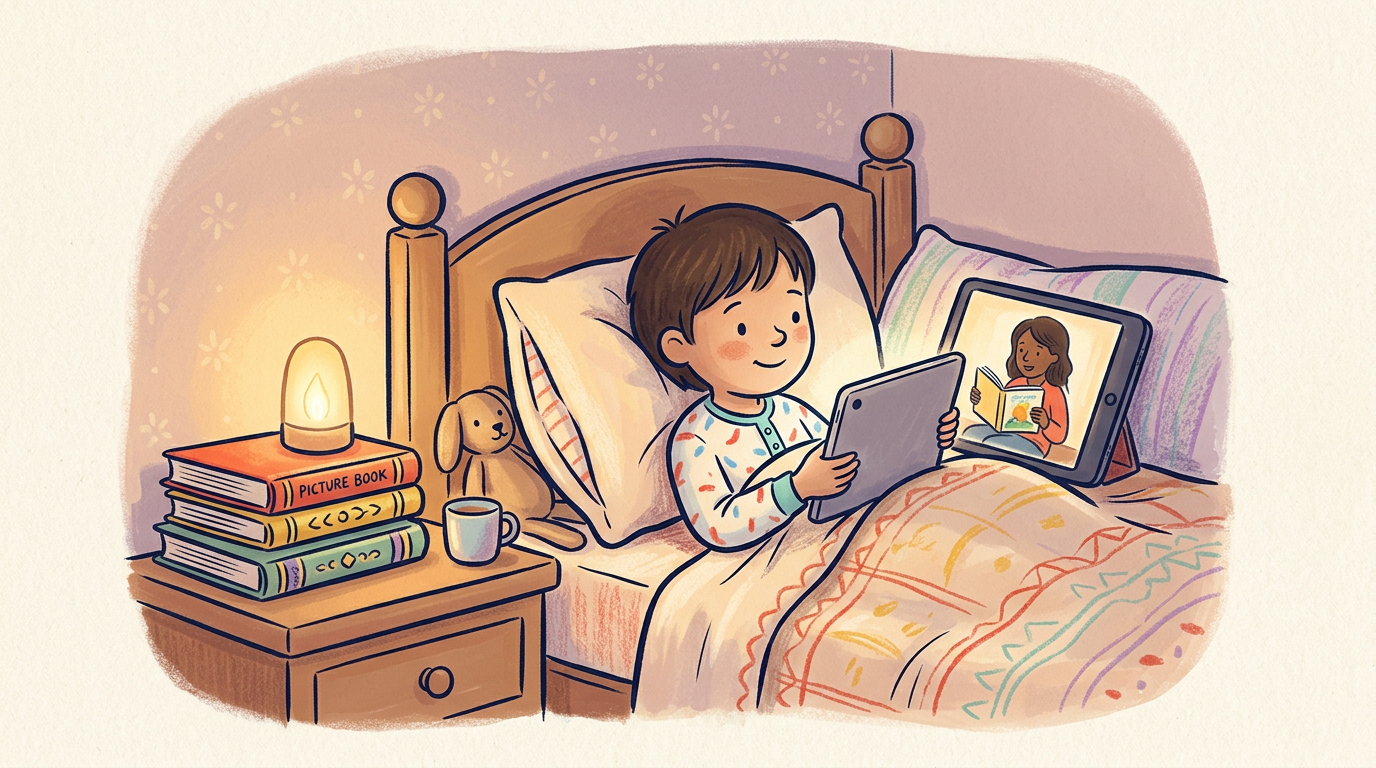
If a work roster, custody arrangement, hospital stay or long-distance family life means you can't read bedtime stories in person, recording yourself reading is worth doing. It won't replace being in the room. But as a way to keep your voice, your face and your presence part of your child's night-time routine, it's a strategy supported by people who work closely with separated families, including an Australian psychologist researching children in military and FIFO households, and by long-running defence-family reading programs overseas.
Does a recording count the same as reading live? No, not quite, and that's okay. Live shared reading has an edge over recordings in most of the research comparing the two (PMC narrative review), largely because the benefit of reading together comes from the warm, responsive back-and-forth between adult and child, not just the words being spoken. A recording can't argue back, can't notice your child's face falling on a sad page, can't pause when they want to talk about the pictures. But it can do something live reading from a distance can't: it can be replayed at 7pm on a Tuesday when you're hundreds of kilometres away, exactly when you both need it. Used as a bridge rather than a substitute, it's a tool worth having.
TL;DR
- Recorded read-alouds are a recommended coping strategy for FIFO, defence, shared-custody and long-distance families, but they work best alongside live reading, not instead of it. Treat them as a "hearing Mum/Dad's voice" ritual, not a reading-instruction replacement.
- The research is honest that live, interactive reading beats recordings for language development, because the benefit comes from the back-and-forth, not just the words (PMC review).
- Keeping some kind of daily routine, recorded reading included, is a protective factor identified in Australian research on FIFO families.
- Australian copyright law allows you to record a book you own for your own family's private, domestic use, but not to upload it publicly or store it on shared cloud drives beyond your household. Check the Australian Copyright Council's guidance if you want certainty.
- A five-to-six-book recording session the night before you leave, plus live phone or video reads when rosters allow, covers most families' needs.
- If your child becomes more upset after hearing a recording, that's a known reaction worth adjusting for, not a sign you've done something wrong.
Why bother recording at all?
It's a fair question, especially when you're exhausted, packing a kit bag, or sitting in a hospital corridor with fifteen minutes before visiting hours end. Hearing a parent's voice and seeing their face offers children reassurance and helps with emotional regulation during unpredictable or stressful stretches. That's the reasoning behind United Through Reading, a long-running program supporting US military families through recorded and video storytime (this is an overseas organisational program, not independent peer-reviewed research). A recorded book can become a cherished, repeatable ritual that anchors a child when the rest of their routine is in flux.
That anchoring matters more broadly too. Australian research into FIFO families has pointed to keeping a day-to-day routine, regardless of whether the FIFO parent is home or away, as a protective factor for children coping with a parent's absence (AIFS Child Family Community Australia). Bedtime reading is often one of the most reliable routines a family has, which is exactly why it tends to fray first when someone is away. A recording lets you keep that routine running even when you physically can't be there.
There's also a gentler, preparatory use: reading your child stories about parents who work away from home (fly-in fly-out dads, army mums, miners, nurses on night shift) can help normalise the situation before a trip, rather than leaving a child to piece it together alone.
What the evidence actually says, and where it's honest about limits
Live reading has an edge most of the time. A narrative review of shared-reading research found that most studies showed live reading sessions were more beneficial than recorded reading for building children's language abilities, although at least one study found no significant difference between the two (PMC, narrative review). The reviewers point to the mechanism: warm, sensitive interaction during the reading session, the pauses, the questions, the noticing, is what seems to drive the language benefit, not simply the act of a story being read aloud (PMC, same review).
Shared reading in general is well established as good for language. Across the broader evidence base, shared book reading supports children's oral language development and vocabulary growth, one of the more consistently replicated findings in early literacy research (Frontiers in Psychology meta-synthesis). That's a reason to keep live reading as the main event whenever you're physically present, and to lean on recordings specifically for the nights you can't be.
Program satisfaction data is useful but different from clinical research. United Through Reading and similar programs report high parent and family satisfaction, with families saying the recordings strengthened bonds or helped a child's love of reading. That's meaningful, lived feedback from thousands of military families, but it's organisational self-reported evaluation data, not independent peer-reviewed science, so it's worth holding it in that category rather than treating it as settled proof.
Put together, the evidence supports recorded reading as a genuinely helpful connection and routine tool, just not as a stand-in for the language-building power of reading together in person.
Is it legal to record myself reading a book?
This is one of the most common practical worries, and the honest answer is that it depends on how you use the recording, not whether you make it.
Under the Copyright Act, "private and domestic use" covers use on or off your own premises, and a recording can be lent to a family member or household member so long as it stays within that person's private, domestic use. In practice, recording a bedtime story from a book your family owns, for your own child or a grandchild, generally sits within the kind of personal-use allowance the Act makes room for.
Those allowances are limited, though, and it's easy to step outside them without realising. You generally cannot upload or host the recording anywhere public, including unlisted YouTube links or open social media, cannot store your copy on someone else's device or in cloud storage outside your immediate household, and cannot sell, trade or lend the recording more broadly, unless the use happens to fall under a specific fair dealing exception. A video sent privately between your own phone and your partner's, or played directly to your own child, is a very different thing in copyright terms to the same video posted publicly or shared through a family group cloud drive accessible beyond the household.
StoryNest can't give you a definitive legal ruling. Copyright law has genuine nuance, and your situation (a grandparent overseas, a shared-custody household, a hospital stay) can shift the picture. The Australian Copyright Council publishes a dedicated, plain-English fact sheet, Copying & Converting Formats for Private Use, which is the right place to check if you want certainty rather than forum opinion. If you have a specific concern, say, you want to share a recording with extended family overseas, or host it on a private family app, it's worth reading that fact sheet or contacting the ACC directly.
A simple rule of thumb keeps most families safely inside the guidelines: record books you own, keep the recording on devices within your own household, and don't post it publicly or store it somewhere outsiders could access it.
How to make a recording that actually works
You don't need studio equipment. A phone propped on a shelf is enough. What matters more is pacing and warmth.
The night-before-you-leave session (FIFO, defence, hospital admission)
A practical approach many families use: the night before departure, record five or six short stories in one sitting. Include your child's current favourite picture book (the one they'd ask for anyway) and one new book they haven't heard yet, so there's something fresh partway through the trip. For each one:
- Speak slowly and a little more expressively than you might normally. The camera and microphone flatten tone more than you'd expect.
- Pause after each page, long enough for the child or the at-home parent to turn the page in sync.
- Hold the book so the pictures are visible on camera, not just your face, if your child likes to look at the illustrations while listening.
- Finish with a short, specific personal message, such as "Goodnight, mate, I'll see you in two sleeps," rather than ending abruptly when the story finishes.
- Keep each file short and clearly named (book title and date) so the at-home parent can find the right one quickly at 7pm on a tired night.
The live phone or video alternative
Where rosters, time zones or hospital wifi allow, reading live over a phone or video call is a lower-prep option and gets you closer to the interactive quality that research favours. Many FIFO workers find it practical to take a copy of the current bedtime book to site, so both ends of the call are looking at the same pages at the same time. This won't always be possible; some rosters and locations make live calls unreliable, which is exactly why having pre-recorded stories as a backup matters.
Keep the order of priority clear
The at-home parent or carer should keep live reading as the main nightly activity whenever they're present, using the recordings specifically on nights the away parent can't be reached live. Frame it to your child as "hearing Dad's voice" or "Nanna's reading time," not as the reading lesson for the night. That framing keeps the recording in its proper place as connection, not instruction.
A worked example: a two-week FIFO swing
| Step | What to do |
|---|---|
| Night before departure | Record 5-6 short stories: 1 new book, rest are current favourites. Add a personal goodnight message to each. |
| During the swing (most nights) | At-home parent reads live as usual. This stays the primary routine. |
| During the swing (away-parent "specials") | Play one recorded story 1-3 times a week, or on nights the roster makes a live call impossible. |
| When a live call is possible | Read together over video using matching copies of the same book, page by page. |
| On return | Read the "new" book together in person as a small reunion ritual, bookending the trip. |
What age does this actually help?
Recorded reading tends to land best with toddlers through to early-to-mid primary school, roughly ages two to eight, when a familiar voice and a predictable bedtime ritual carry a lot of emotional weight, and when children are used to being read to rather than reading independently. Older primary-aged children can still enjoy it, but they may get more out of a live video call where they can talk about their day, or a recording that includes a personal chat alongside the story rather than the story alone. There's no hard cut-off. Some kids outgrow the ritual earlier, some hang onto it longer, so let your own child's response guide you rather than their age bracket.
My child got more upset hearing the recording. Is that normal?
Yes, this happens, and it isn't a sign you've made a mistake. Hearing a parent's voice without the parent physically present can sometimes highlight the absence rather than soften it, especially in the first few days after a departure or in a child already feeling unsettled. If this happens, it's worth pulling back on the recordings for a few days, leaning on the at-home parent's live reading instead, and reintroducing the recording later alongside something concrete and comforting, such as a cuddly toy, a countdown chart to the return date, or playing it earlier in the evening rather than right at lights-out. If distress is persistent or seems to be getting worse rather than settling, it's worth mentioning to your child's teacher or GP, or speaking with a psychologist experienced in family separation, rather than troubleshooting alone.
Questions parents and teachers ask
Can I share the recording with grandparents or family overseas?
You can generally share a recording within your own family's private, domestic circle, for example sending a video directly to a grandparent to play for your child during a visit. What you shouldn't do is post it publicly (social media, open YouTube links) or store it on shared cloud platforms accessible beyond your household, as this moves outside the personal-use allowances in the Copyright Act. If you want a recording specifically to send grandparents overseas, the safest approach is a direct, private message or file transfer rather than a public or semi-public upload. For certainty on your specific situation, the Australian Copyright Council's fact sheet on copying for private use is the authoritative reference.
What's the real difference between a pre-recorded video and reading together over a video call?
A pre-recorded video is one-directional and can be replayed any time, which makes it reliable when rosters, time zones or hospital visiting hours make live contact unpredictable. A video call is interactive: your child can ask questions, show you something off-screen, or just chat, which research suggests is closer to the warm, responsive interaction that drives language benefits in shared reading. Where possible, live video reading is the stronger option for connection and language; pre-recorded stories are the reliable backup for nights live contact isn't possible.
How many recordings should I realistically make before I leave?
There's no fixed number, but five or six short stories recorded in one sitting the night before departure is a manageable, realistic target for most parents, enough to cover roughly a week to two weeks if used a few times weekly rather than nightly, with live reading or calls filling the gaps. You don't need to record a story for every single night away. A handful of well-made recordings, used as a special addition rather than the nightly default, tends to work better than an exhausting marathon recording session.
Should I use my recorded voice for reading practice instead of reading time?
No, that's a different use case with a different purpose. Recordings of an adult reading aloud, covered in this article, are about maintaining connection and routine during separation. Recording a child's own voice reading aloud for repeated-reading fluency practice is a separate literacy strategy with its own evidence base; see StoryNest's existing resource on recording your child reading aloud for that approach. Mixing the two up can lead to confusion about what each is actually for.
Is this appropriate for a hospital stay, not just FIFO or defence families?
Yes. The same logic applies whether the absent person is a parent on deployment, a FIFO worker on swing, a parent in a hospital bed, or a child who is themselves hospitalised and separated from siblings or a parent at home overnight. The common thread is physical separation during what would normally be a shared bedtime routine, and a recorded or live-called story can help bridge that gap regardless of the reason for the separation. Hospital social workers or child life therapists, where available, can also be a helpful resource for setting this up sensitively around a hospital stay.
Does this work for shared custody, not just long-distance separation?
Yes, and it can be particularly useful on nights a child is with one parent but misses a bedtime ritual usually shared with the other. A short recorded message or story from the parent who isn't present that night can soften the transition between households, provided both parents are comfortable with the arrangement. As with any shared-custody routine, it tends to work best when it's set up by mutual agreement rather than introduced unilaterally, to avoid it becoming a point of tension between households.
Where can I find more support for building a reading routine around a family separation?
StoryNest's resources hub has broader guidance on building sustainable reading habits, and families wanting a structured way to keep reading going across households or during travel can look at the StoryNest app for shared, flexible reading routines. Teachers supporting a student through a family separation may also find it useful to flag the situation gently and check in on reading routines at school; see StoryNest for Schools for classroom-side resources.
Sources
- Australian Institute of Family Studies, Child Family Community Australia, FIFO families research paper
- A narrative review of the effect of parent, child shared reading in preterm infants, PMC
- Parent, child shared book reading challenges and facilitators: a systematic review and meta-synthesis, PMC
- United Through Reading, Our Impact
- United Through Reading, Our Program
- Australian Copyright Council, Copying & Converting Formats for Private Use fact sheet
- Queensland Law Handbook, Exceptions to Copyright Infringement
- Deakin University Library, Exceptions to Copyright
- How Are FIFO Parents Treated in Parenting Arrangements, Hickman Family Lawyers
Keep the next story going.
All resources