From the StoryNest reading nook
Decodable, levelled or "just right"? How to pick your child's next book
Decodable booklet, levelled home reader or library picture book: which one tonight? A clear, evidence-based guide for Australian parents and teachers.
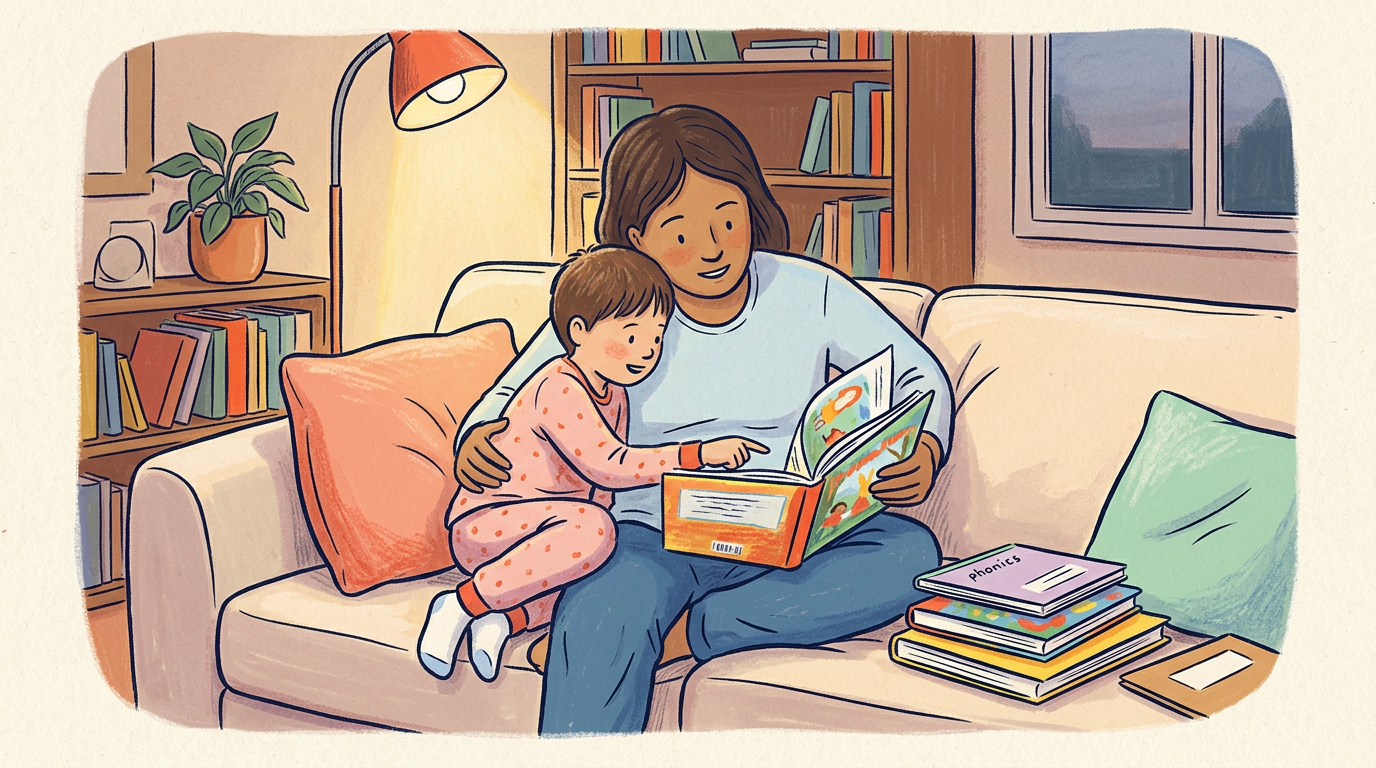
You're standing there with three books in your hands: the colour-coded home reader that came in the school bag, a slim decodable phonics booklet, and a gorgeous picture book borrowed from the library. Your child wants the picture book. You're not sure which one counts as "reading practice."
Here's the short answer: for phonics practice, reach for the decodable book that matches what your child has been taught this term. Save the levelled or library book for a relaxed, shared read where you do most of the reading aloud. They do different jobs, and they aren't interchangeable.
This mix-up trips up a lot of families, and for good reason. Many of us grew up with (or remember our older kids using) colour-wheel levelled readers and the "five-finger rule" for finding a "just right" book. Australian schools have since shifted towards systematic synthetic phonics (SSP) and decodable texts in the early years, and the logic behind book selection has changed with it. Once you understand why, choosing the right book for tonight gets easier.
TL;DR
- Decodable books are sequenced by the phonics code your child has actually been taught. Every word should be sound-out-able, not guessable from pictures.
- Levelled readers are graded by surface features like word length and sentence complexity, an approach from the earlier "whole language" era that doesn't line up neatly with phonics teaching (Reading Rockets).
- Australian curriculum and state guidance now point towards decodables for phonics practice in the first years of school, alongside rich read-aloud books for vocabulary and a love of story.
- The five-finger rule is a handy, low-stakes self-check for independent library picks once a child is reading more fluently, but it's a folk heuristic rather than strong evidence, and shouldn't be used to choose phonics practice books.
- If a home reader seems too easy or full of unfamiliar spelling patterns, ask the teacher which sounds have been taught so far rather than swapping to a harder-looking book.
- Decodables shouldn't be the only books in your child's world. Picture books, read-alouds and audiobooks all matter for vocabulary, comprehension and the simple enjoyment of stories.
Why there are suddenly three different kinds of "levelled" books
If you've got kids a few years apart, you may have noticed your younger child's reading bag looks nothing like your older child's did. That's not inconsistency on the school's part. It reflects a genuine shift in how reading is taught.
Levelled readers grade books using things like word length, sentence structure, punctuation, amount of text on the page and font size. This approach was developed during the whole language era of teaching reading (Reading Rockets). It assumes a child can use picture clues, context and memorised sight words to work out what a book says, with difficulty increasing gradually across those surface features.
Decodable texts work differently. They're sequenced not by how a book looks, but by which letter-sound (grapheme-phoneme) relationships a child has actually been taught in class. A decodable book matched to "Set 6" sounds, for example, will only use words built from the sounds taught up to and including Set 6, nothing more.
This matters because using decodable texts as part of literacy instruction means beginner readers should only be given texts containing grapheme-phoneme correspondences they've already been taught. Several Australian decodable publishers go further and recommend against using levelled texts at all during the first few years of learning to read, favouring decodables for practice alongside rich read-aloud texts for building vocabulary and comprehension (Decodable Readers Australia FAQs).
It's built into curriculum and policy, not just a classroom trend
The Australian Curriculum's own definition of "decode" was revised in 2019 to focus on the code itself: a process of efficient word recognition in which readers use knowledge of the relationship between letters and sounds to work out how to say and read written words. That's a shift away from the earlier definition, which leaned on "contextual, vocabulary, grammatical and phonic knowledge" working together.
State and territory guidance backs this up:
- Victoria is explicit that decodable texts are used to practise blending and decoding skills and to build automaticity and fluency, and that texts should contain only previously taught code (Victorian Department of Education, Phonics Plus scope and sequence).
- Western Australia directs teachers to use systematic synthetic phonics, and in one study 93% of teachers reported teaching phonics using an SSP approach. Researchers there have argued that predictable, picture-cued texts are incompatible with phonics instruction because they don't support beginning readers to master the written code (AARE blog).
- Queensland's system-wide Reading Commitment requires schools to teach synthetic phonics systematically and explicitly, introduce beginning readers to decodable texts, and assess decoding skills directly.
The Australian Education Research Organisation's (AERO) national evidence base explains the cognitive science of how children learn to read and names phonemic awareness and phonics among five essential keys to reading, alongside oral language development (Firefly Education / Sound Waves research summary).
If your child's school has moved to decodable readers, it reflects this evidence-aligned national direction, not an arbitrary change.
So which book goes with which kind of reading time?
Here's a simple way to think about it, using a realistic Foundation/Year 1 week.
A family brings home two reading bags in the same week: a decodable booklet from the school's SSP program (matched to the sounds taught so far) and a brightly illustrated picture book borrowed from the library.
| Book type | Best used for | What to expect from your child | Your role |
|---|---|---|---|
| Decodable booklet (matched to taught sounds) | Focused, 10 to 15 minute phonics practice | Every word should be sound-out-able using sounds already taught | Listen, prompt gentle sounding-out, resist giving the word too quickly |
| Levelled home reader | Building reading confidence and fluency, if used alongside decodables | May mix taught and untaught patterns, so check with the teacher what it's meant to achieve | Support as needed; don't expect pure independent decoding |
| Library picture book | Relaxed shared reading, vocabulary, story-love | Child listens, joins in, asks questions, with no pressure to decode | You read most or all of it aloud, with warmth and enjoyment |
A practical test for the decodable booklet: if your child is guessing words from the pictures rather than sounding them out, the text is probably mismatched to what's actually been taught, not a sign your child is behind. It's worth flagging this with the teacher rather than persisting with a frustrating mismatch.
A simple script for talking to the teacher
You don't need to diagnose the mismatch yourself. A short, friendly question does the job: "Which sounds has my child been taught so far this term? I want to make sure I'm matching our home reading to that."
This lets you calibrate with real information instead of guessing by how long or short a book looks. Most teachers are glad to share this, and it's exactly the kind of parent partnership that makes home practice useful rather than accidentally counterproductive.
What about the five-finger rule?
Many of us have seen the five-finger rule on a library poster or reading app: pick a book, open to a page, read it, and raise a finger for every unknown word. More than five fingers up by the end of the page, and the book's considered too hard.
It's a catchy, low-stakes way to help an independent reader choose a library book they'll enjoy without constant stumbling. But it's worth knowing its limits. Literacy researcher Timothy Shanahan has argued that the idea children should mainly read at their "instructional level" isn't well supported by research, pointing to more than half a dozen studies, including a 2010 study by O'Connor, Swanson and Geraghty, that found no clear benefit to sticking rigidly to instructional level reading (EdWeek, Shanahan). That research comes from the US context, but the underlying caution applies here too: a word-counting heuristic is not the same thing as a genuine match to a child's phonics knowledge.
For Australian families, the five-finger rule can be a reasonable, relaxed self-check for a child browsing for pleasure reading once they're past the earliest decoding stage. It should not be used to choose or restrict phonics practice books. For that, what matters is whether the book matches the specific sounds your child has been explicitly taught, not how many unfamiliar words appear on a page.
Should decodables be the only books your child ever reads?
No, and no credible Australian guidance says they should be. Decodables are a practice tool for a specific job: letting a beginner reader apply newly taught phonics knowledge successfully and build fluency and automaticity. They're deliberately narrow in vocabulary, precisely so a child can decode independently and feel the satisfaction of cracking the code.
That narrowness is also why decodables alone can't build rich vocabulary, imagination or a love of story. Victorian guidance pairs decodable practice with "simple authentic texts" for fluency work and recommends teacher-led choral reading, partner reading and repeated reading using both text types. NSW Department of Education guidance for EAL/D learners is direct on this point too: decodable texts should not be the sole reading material for children learning English as an additional language (NSW DoE FAQs, EAL/D learners and decodable texts). For these learners, oral language and vocabulary-rich exposure matter alongside decoding practice, so picture books, read-alouds and conversation-rich time together remain essential rather than optional extras.
A healthy reading diet for a Foundation or Year 1 child typically includes short, focused decodable practice matched to taught sounds (to build the code), shared reading of richer picture books and stories mostly read aloud by an adult (for vocabulary, ideas and connection), and audiobooks or recorded stories that let a child enjoy more complex, engaging narratives than they could decode independently yet.
This last point is where tools like StoryNest's audiobook and recording resources can help, not as a substitute for decodable practice or school phonics instruction, but as a way to keep the enjoyment of story alive while the decoding skills are still being built word by word. A child slogging through "Set 4" decodables at school can still fall in love with a rich, imaginative story read aloud or recorded by a familiar voice at home.
Should you throw out your old levelled library books?
Not at all. Levelled library books still have a place, just a different one than they used to have for formal phonics practice. They can work well for relaxed shared reading, for building general reading stamina once a child is more fluent, or simply for the pleasure of choosing a good book at the library. The key shift is in expectation: don't lean on a levelled book as the measure of whether your child's phonics skills are on track, and don't be alarmed if it doesn't match neatly to what's being taught in class. That's a different job entirely.
Questions parents and teachers ask
My child's home reader seems much harder (or easier) than what they're doing at school, is that a problem?
It depends on what kind of book it is. If it's a decodable booklet, it should match the sounds already taught. If it clearly doesn't, that's worth a quick chat with the teacher, since mismatched decodables can undermine the phonics teaching happening in class. If it's a levelled or general reader, some variation in apparent difficulty is normal and less concerning, because these books aren't built on a taught-sounds sequence in the first place. The simplest fix either way is asking the teacher which sounds or stage your child is currently working on.
Should I throw out our old levelled library books?
No. They're better suited to relaxed shared reading and building general reading enjoyment than to focused phonics practice. Keep using them for bedtime stories, read-alouds and library visits, just don't use them as the main tool for decoding practice in the early years of school.
Is the five-finger rule a good way to choose books?
It can be a fine, low-stakes way for a reasonably fluent independent reader to self-select an enjoyable library book. It is not well supported as a precise measure of "instructional level," and research summarised by literacy researcher Timothy Shanahan has found little evidence that sticking to a calculated instructional level improves outcomes. For phonics practice specifically, it shouldn't be used at all. The taught-sounds match matters far more than a finger count.
What's the difference between a decodable book and a "learn to read" or "early reader" book from the shops?
Shop "early reader" or "learn to read" series are usually levelled by general features like sentence length, repetition and vocabulary familiarity, similar to levelled readers, rather than by a specific, taught phonics sequence. A genuine decodable text is built around a defined scope and sequence of letter-sound correspondences, so a child can only succeed by applying phonics knowledge rather than guessing or memorising. It's worth checking the back cover or publisher notes, as not everything marketed as a "phonics reader" is a true decodable matched to a specific teaching sequence.
My child hates their decodable readers because they're boring, what do I do?
This is a common and understandable complaint: decodables are deliberately limited in vocabulary, so they can feel flat compared with a vivid picture book. It helps to frame decodable time as short, focused practice (10 to 15 minutes, not a whole reading session) and to follow it immediately with a favourite story read aloud by you, purely for enjoyment, with no decoding expectation attached. That contrast helps children understand that both kinds of reading matter, for different reasons.
Should every book my child reads be one they can decode perfectly?
No. Only their dedicated phonics practice books need to be fully decodable based on taught sounds. The rest of their reading diet, including picture books, shared stories and audiobooks, can and should include richer language than they can decode independently, since an adult is doing the reading or the words are heard rather than sounded out. Richness of vocabulary and story matters just as much as decoding accuracy, just in a different part of the reading routine.
How is this different for a child learning English as an additional language?
For EAL/D learners, decodable texts remain useful for the same phonics-practice purpose, but NSW Department of Education guidance is clear that decodables should not be the sole reading material for these children. Oral language development, vocabulary exposure and rich, meaningful texts matter even more here, since children are often building English vocabulary and decoding skills at the same time. A broad mix of decodable practice plus plenty of read-aloud, conversation and shared stories supports both goals together.
The bottom line
There's no single best book, just a best book for the specific job in front of you tonight. For focused phonics practice, match the book to the sounds your child has actually been taught, and treat a mismatch as useful information rather than a worry to carry alone. For everything else, building vocabulary, imagination and a lasting love of reading, lean into richer stories, read aloud together, and let an audiobook or a recorded story carry a tale your child couldn't yet decode on their own. If a mismatch or a persistent struggle continues despite matching books correctly, it's reasonable to raise it with your child's teacher or a qualified literacy professional, who can look at the fuller picture.
You can explore more practical, evidence-aware reading guides at StoryNest's resource hub, browse story and audiobook options at storynest.com.au, or see how schools are using StoryNest alongside classroom phonics programs at StoryNest for Schools. Families wanting to get started can create a free account to explore age-appropriate stories for shared reading time.
Sources
- Reading Rockets, Choosing and Using Classroom Texts
- Reading Rockets, Using Decodable Books
- Decodable Readers Australia, FAQs
- Decodable Readers Australia, Instructional Teaching Guides
- AARE blog, Decodable or predictable: why reading curriculum developers must seize one
- Firefly Education, Sound Waves: Research insights into systematic synthetic phonics
- NSW Department of Education, FAQs: EAL/D learners and decodable texts
- EdWeek, Should Teachers Still Be Using 'Just Right' Books?
Keep the next story going.
All resources