From the StoryNest reading nook
My child gets stuck on a word. What do I actually say?
A practical, evidence-aware script for the moment your child stalls on a word during home reading: what to say, what to avoid, and why.
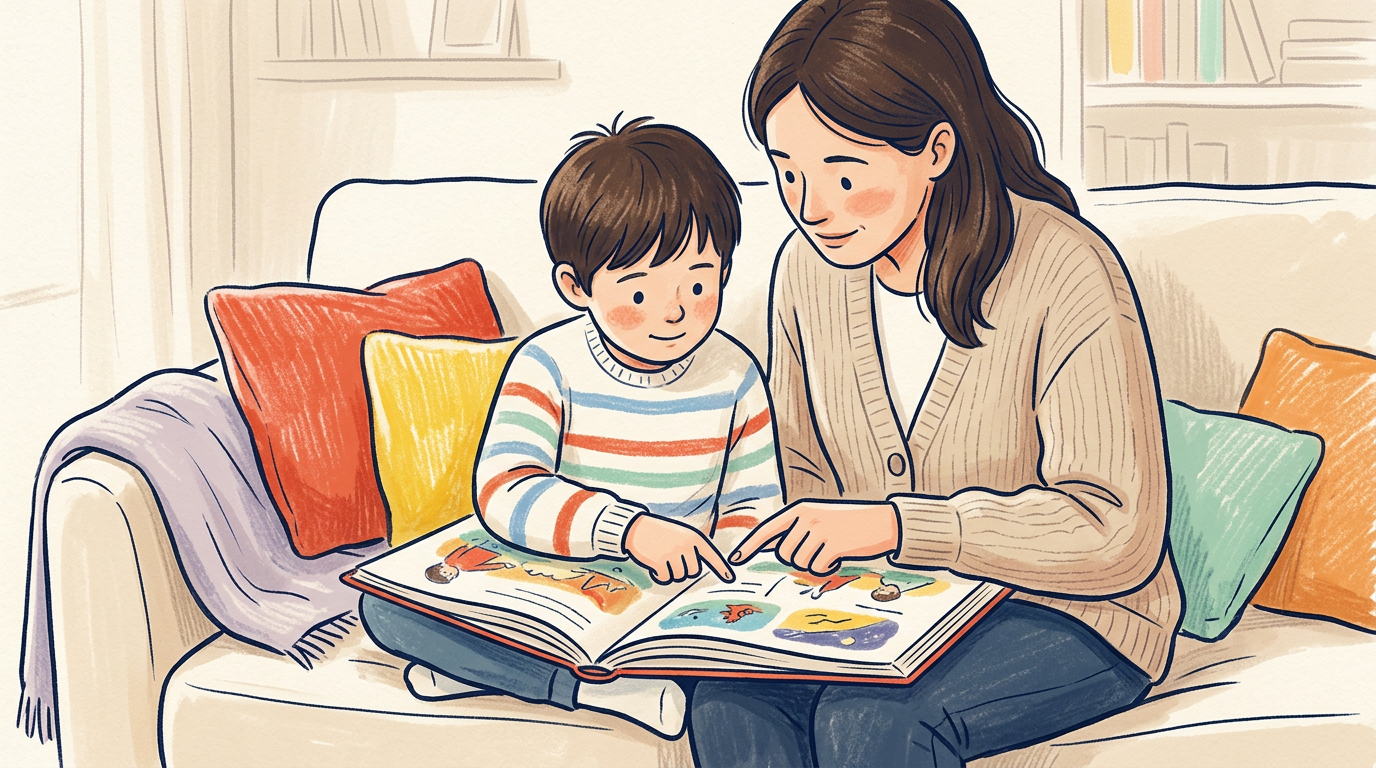
Your child is reading their home reader out loud, cruising along nicely, and then they hit a word and just stop. Two seconds. Four seconds. You can feel yourself wanting to jump in. What you say in that window matters more than most parents realise. If you learned to help with reading back in the 1990s or 2000s, the advice you probably remember ("sound out the hard bits, or just look at the picture and have a guess") isn't quite what's recommended anymore.
Here's the short version: pause for a few seconds before helping, then prompt your child to look at the letters and sounds in the word rather than guessing from the picture or the sentence around it. If they're still stuck after one good go, tell them the word and keep reading. Save "does that make sense?" for checking understanding after a sentence is read, not as a way to guess a word before it's decoded. The rest of this guide walks through why, and gives you a script you can use tonight.
TL;DR
- Wait 3 to 5 seconds before helping. Don't jump in the instant your child hesitates.
- Prompt letters and sounds first ("sound it out," "break it into chunks"), not pictures or guessing from context. This is what current Australian phonics-focused teaching recommends.
- If they're still stuck after one focused prompt, tell them the word and move on. Reading practice shouldn't turn into a stand-off.
- Praise the strategy, not just the right answer: "You broke it into parts and blended it, that's exactly what good readers do."
- Keep "does that make sense?" for comprehension checks, not for guessing unknown words.
- This is everyday home-reading support, not a substitute for classroom teaching. If decoding stays hard despite calm, repeated practice, loop in the teacher.
Why the old "look at the picture" advice has changed
If your child's teacher sent home a reading diary with tips like "use the picture to help" or "what word would make sense here?", you're not imagining it. That style of prompting, often called three-cueing, was mainstream for decades. It asks readers to draw on meaning, sentence structure and visual cues, such as the first letter or a picture, together to guess at unfamiliar words.
Research into how skilled readers actually process text shows they're not skim-guessing from pictures at all. They process all the letters in a word, every time, very fast (Castles, Rastle & Nation, summarised via Five From Five). Teaching a child to guess from context instead of attending to letters can reinforce the habits of a struggling reader rather than building the skill that produces independent, accurate reading. Five From Five, an Australian evidence-based reading advocacy group, flags "use pictures or context to guess the word" as a marker of poor-practice home reading guidance.
This tracks a real, visible shift in Australian education policy. A national Year 1 phonics check rolled out from 2019, with NSW adopting it state-wide from 2021, Tasmania in 2022, and Western Australia and Victoria introducing their own versions from 2023. States have been moving deliberately from "balanced literacy" cueing approaches toward more explicit, systematic phonics instruction in the early years. If your child's classroom is teaching explicit phonics but their reading diary, or a well-meaning grandparent, is still saying "guess from the picture," that's a genuinely confusing mixed message for a seven-year-old to hold in their head at the same time.
A note of honesty: this isn't settled science at every margin. A small number of academics still argue that cueing systems describe something real about how proficient readers cross-check meaning against sound (a kind of "coordinated verification" rather than guesswork), and that the research is more nuanced than "three-cueing is simply wrong." StoryNest's position is that the mainstream Australian policy consensus, letters and sounds first, especially for developing readers, is the better-evidenced bet for home reading support, while acknowledging this conversation isn't fully closed in academic circles.
A simple structure: pause, prompt, praise
You don't need to memorise a textbook to do this well. A well-evidenced structure called Pause, Prompt, Praise was developed in the 1970s by researchers at the University of Auckland, working closely with Māori and Pākehā families in South Auckland to support a group of 10- to 12-year-old readers who were finding reading tough. The core insight, pausing before reacting to a child's error rather than jumping straight in, has held up well and is still a sound structure for home reading support today.
Where it needs a modern update is the content of the "prompt" step. The original 1970s version encouraged prompting with both context clues and letter-sounds together, which reflects older cueing theory. Current, phonics-aligned advice keeps the same pause, prompt, praise shape but changes what you prompt with: sounds and letters first, context and "does it make sense" reserved for a separate comprehension check afterwards.
The sequence, step by step
- Pause. Give your child three to five seconds of silence. This feels longer than it is, but it gives their brain a real chance to work the word out before you step in. Jumping in too fast is an easy habit to fall into, and an easy one to fix.
- Prompt with sounds and letters first. Your first prompt should invite them to sound the word out, left to right, blending as they go: "Look at the word, can you break it into chunks and sound each part out?"
- Prompt again, more specifically, if needed. If the whole-word prompt didn't work, narrow it to the exact tricky part: "That letter combination 'ow' can say /ow/, like in 'cow.' Try that bit again."
- If they're still stuck, tell them the word. One or two focused prompts is enough. If it's still not landing, especially for an irregular word or an unfamiliar name, supply the word yourself, have them reread the whole sentence so the word gets practised in context, and keep the story moving. Dragging this out turns reading practice into an ordeal.
- Praise the strategy, specifically. "Yes! You broke it into parts and blended it together, that's exactly what good readers do." Praising the process, not just "good job," helps your child notice what worked, so they can do it again on their own next time.
The aim of every prompt is that your child can eventually run the same steps in their own head without you there, rather than becoming more dependent on you (ASCD, When Young Readers Get Stuck).
Decoding mistakes vs meaning mistakes
Not every stumble is the same kind of problem, and it helps to tell them apart.
A decoding mistake is when your child can't work out what a word says. They stall completely, or they sound out something that isn't a real word at all. This is where the pause, prompt, praise sequence above applies directly.
A meaning (or self-monitoring) mistake is different: your child reads a word confidently, and it's even a real, sensible English word, but it's the wrong one, and it changes the meaning of the sentence. The classic example is a child reading "house" when the text says "horse." If the sentence still makes sense to them, they often won't notice.
This is where "does that make sense?" earns its place, just not as a first resort for decoding. Even beginning readers can learn to monitor their own comprehension as they go, checking whether what they just read sounds right or fits the story, and using fix-up strategies like rereading when it doesn't. Teach this as a separate habit from word-attack, applied after a sentence or page is read: "Wait, a boy riding a house? Does that sound right? Have another look at that word."
The short rule of thumb: letters and sounds to work out an unknown word; "does that make sense?" to check understanding once it's read.
Worked example: Mia and the word "shadow"
Eight-year-old Mia is reading her home reader and stalls on the word "shadow."
- Her dad waits quietly for three to five seconds instead of jumping straight in.
- He then says: "Look at the word, can you break it into chunks? Sh... a... d... o... w." Letters and sounds first, not "look at the picture of the dog."
- Mia blends it: "sh-a-dow... shadow!" Her dad gives specific praise: "Yes! You broke it into parts and blended it, that's exactly what good readers do."
- If Mia had still been stuck after that one focused prompt, her dad would simply supply the word, have her reread the sentence aloud once more, and move on, with no lingering stand-off over one word.
- At the end of the page, her dad asks a separate comprehension check: "Did that make sense, a shadow following the dog?" That's the self-monitoring habit, kept distinct from the decoding moment.
A quick-reference prompt card
This is worth printing, sticking on the fridge, or keeping in the back of the reading diary. It also works as a laminated card for reading volunteers or teacher aides, replacing older "look at the picture" cards that may still be floating around some school book boxes.
| Step | What to say | What to avoid |
|---|---|---|
| 1. Pause | Wait silently, 3 to 5 seconds | Jumping in immediately |
| 2. Prompt (sounds) | "Sound it out, start to finish, then blend it." | "What do you think it could be?" |
| 3. Prompt (specific) | "That letter pattern says ___, like in ___." | "Look at the picture." |
| 4. Supply if needed | "That word is ___. Try the sentence again." | Long, repeated guessing attempts |
| 5. Praise | "You broke it into parts, that's what good readers do." | "Good job" (too vague to be useful) |
| After reading | "Did that make sense?" (comprehension check) | Using "does it make sense?" to guess an unread word |
Questions parents and teachers ask
Should I ever let my child use the pictures to help with reading?
Yes, just not for working out what a word says. Pictures are genuinely useful for enjoyment, for building vocabulary, and for supporting comprehension and conversation about the story, such as "look, the dog's shadow is huge here, I wonder why." What's discouraged is using the picture as a strategy to guess an unknown word instead of sounding it out. Keep pictures for meaning and delight; keep letters and sounds for decoding.
My child's teacher told us to use "look at the picture". Is that wrong?
Not necessarily wrong for your specific classroom, but it's worth a gentle check-in. Practice varies between schools and even between year levels, and some older resources, including laminated prompt cards and reading diaries, haven't caught up with the current evidence base yet. Rather than assuming anyone's made a mistake, it's reasonable to ask your child's teacher what approach the class is currently using and which phonics sounds or patterns they're working on, so your support matches the classroom.
How long should I actually wait before helping?
Somewhere around three to five seconds is a sensible target: long enough to give your child a genuine chance to work it out themselves, short enough that it doesn't tip into frustration or boredom. It will feel longer than it sounds in the moment; many parents find themselves jumping in after barely a second without realising it.
Is it ever okay to just tell my child the word?
Yes, and it's the recommended move once you've given one or two focused prompts and your child is still stuck. This applies especially to irregular words, unfamiliar names, or words well above their current phonics stage. Supplying the word, having them reread the sentence, and continuing on protects the flow of the story and keeps reading enjoyable, which matters just as much as decoding accuracy.
What if correcting every single mistake makes my child hate reading?
This is a real risk, and it's worth taking seriously. Not every slip needs a stop-and-fix. If a mistake doesn't change the meaning, such as reading "a" for "the," it's often fine to let it go and keep the momentum going. Save your prompts for moments that genuinely affect meaning or decoding, and balance correction with warmth, books your child actually enjoys, and plenty of specific praise. If motivation feels like the bigger issue in your house right now, StoryNest's other resources go into that side of things in more depth.
Does this approach apply to older kids, not just beginner readers?
The core structure, pause, prompt toward letters and sounds, praise the strategy, works right through primary school, though the content shifts. A Foundation or Year 1 reader might be stuck on simple consonant-vowel-consonant words; a Year 5 reader is more likely to stall on a long multisyllable word like "extraordinary" or an unfamiliar topic word in a non-fiction text. For older readers, prompting them to spot smaller known chunks inside the bigger word, such as syllables, prefixes or familiar word parts, is the equivalent move.
My child read a different but sensible word, like "house" for "horse". Should I interrupt?
This is a meaning mistake rather than a pure decoding failure, and it's a good moment to use a comprehension check rather than a sounding-out prompt. Let them finish the sentence, then ask something like "did that make sense, riding a house?" to prompt them to notice and self-correct. This builds the habit of monitoring their own understanding as they read, which is a separate and equally important skill from decoding individual words.
Where this fits with everything else you're doing
What to say in the stuck-word moment is one piece of a bigger picture, alongside choosing books your child actually wants to read, making space for listening to stories as well as decoding them, and building in enough low-pressure practice that reading starts to feel automatic rather than effortful. StoryNest's resources hub and home page have more on book selection, motivation and fluency, and our schools page outlines how the same evidence-based thinking applies in a classroom or small-group setting. You can also create a free account to explore how it fits into your family's routine.
One last note: this guide is about everyday home reading support, not a substitute for classroom phonics instruction or professional assessment. If your child is consistently unable to decode words expected for their age, despite calm, repeated practice over several weeks, that's a good reason to have a chat with their class teacher, rather than a basis for trying to work out on your own whether something like dyslexia might be involved. Teachers and, where needed, speech pathologists are best placed to assess and guide next steps.
Sources
- Five From Five, What is wrong with three cueing?
- Five From Five, Effective teaching of reading
- ASCD, When Young Readers Get Stuck
- Shanahan on Literacy, Time to Tell Parents the Truth about Helping their Kids with Reading
- Shanahan on Literacy, Three-Cueing and the Law
- Reading Rockets, Time to Tell Parents the Truth about Helping their Kids with Reading
- Reading Rockets, Reading Instruction at Your Child's School
- Wikipedia, Three cueing
- Wikipedia, Reading Recovery
- AERO, Evidence-based teaching practices
- AERO Start-Up Guide
Keep the next story going.
All resources