From the StoryNest reading nook
"My child says reading is boring": an evidence-based guide to rebuilding reading motivation (ages 5-12)
Your child can read but won't choose to? Here's what the research says about rebuilding reading motivation in kids aged 5 to 12, and what actually helps.
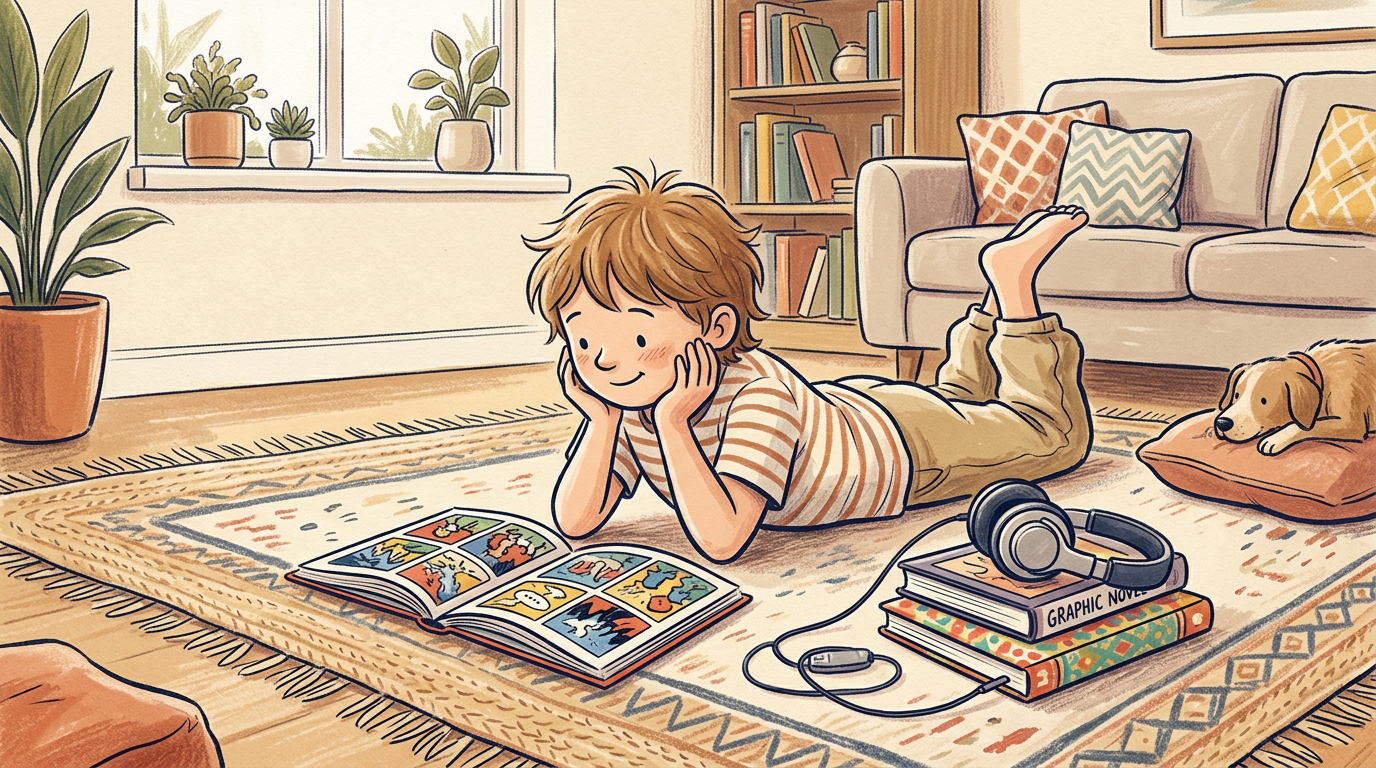
If your child can read, or is well on the way, but flatly refuses to pick up a book, calls reading "boring," or groans every time the home reading diary comes out, this isn't a decoding problem. It's a motivation problem, and the two need different fixes.
Reading motivation has been studied in real depth, and the picture is encouraging: enjoyment isn't fixed, and it isn't really about finding the one magic book. It has much more to do with how much choice and control your child feels they have over their own reading life. The evidence points towards small, deliberate shifts rather than more pressure, more logs or more "just one more chapter." This guide covers what's going on, what the research says works, and what to try this week.
TL;DR
- A motivation dip is common and measurable: in the most recent PIRLS assessment, only 29% of Australian Year 4 students said they very much like reading, and 26% said they don't like it at all (ACER/PIRLS 2021).
- Choice is the most consistently supported motivational lever in the research, more so than rewards, logs or pep talks (Bains & colleagues, 2025; self-determination theory research).
- Mandatory reading logs can backfire. One study found they were linked to declining interest in recreational reading compared with voluntary logs (Pak & Weseley, 2012). It's one small US study, not settled fact, but worth reflecting on.
- Comics, graphic novels and audiobooks count as real reading. The International Literacy Association has affirmed graphic novels and comics as legitimate texts that build comprehension and a love of story (ILA, 2021).
- Motivation strategies don't replace checking that reading is at the right level of challenge. If a child avoids reading because it's too hard, that's a conversation for their teacher, not a motivation fix.
Why Year 4 is a pinch point
Reading researchers pay particular attention to around Year 4 because that's typically when children shift from "learning to read" to "reading to learn", using reading as a tool to access information rather than practising the skill itself (ACER/PIRLS). Books get longer, less picture-supported and more demanding, right as school workload ramps up.
Australia's results at this transition are a real signal, not a one-off. In the most recent PIRLS data, only 29% of Australian Year 4 students reported that they very much like reading, 45% said they only somewhat enjoy it, and 26% said they don't like reading at all (Teacher Magazine, PIRLS 2021). Australia ranked 21st out of 50 participating nations on reading enjoyment. It doesn't improve with age on its own, either: one Australian report on youth reading found that around one in three Australian children can't read proficiently, and 29% of teenagers are choosing not to read for pleasure at all (AustraliaReads.org.au).
This matters because enjoyment and achievement travel together. Students who report enjoying reading, feeling confident as readers, or feeling engaged in reading lessons tend to perform at higher levels than those who don't (The Conversation, 2023). It's worth flagging a caveat here: this is correlational, self-reported data. It tells us enjoyment and achievement are linked, not that boosting enjoyment alone will lift a child's reading score. Still, it's a good reason to take "boring" seriously rather than brushing it off.
Is it your fault your child doesn't like reading?
No, and it's worth saying plainly before anything else. A motivation dip around the primary years is common, measurable at a population level in Australia, and driven by a mix of developmental, curricular and social factors well beyond any one family's control. It isn't a sign you haven't read to your child enough, bought the right books, or modelled reading correctly.
The research does point to specific, learnable things that tend to help, and a few well-meaning habits that can unintentionally make things worse. That's useful, because it means there's something concrete to try.
The three things motivated readers consistently have
The dominant framework in reading-motivation research is self-determination theory, which proposes that motivated readers need three things:
- Autonomy: a sense of choice and control over what and how they read.
- Competence: a feeling of being capable, a positive "I am a reader" identity, not just technical skill.
- Relatedness: feeling part of a community of readers they can talk to and connect with.
Literacy researchers have linked this framework to reading, concluding that pupils need "a high degree of agency, volition and choice (autonomy), a sense of self-efficacy and a positive reader identity (competence), and… to feel part of a network of readers with whom they can connect (relatedness)" to stay motivated (Cremin, Open University/NATE).
Of the three, choice has the strongest and most direct experimental evidence behind it.
Why choice matters so much
A recent study found that simply having choice over what to read increased both how much participants enjoyed reading and how much they were willing to pay for books afterwards (Bains & colleagues, 2025). Broader reviews of the literature back this up, noting that choice and personal interest significantly boost intrinsic motivation and engagement with reading material (Reading Motivation: Classroom-Based Instruction).
This lines up with what a lot of parents notice: the child who insists a chapter book is "too boring" will happily lose an hour to a comic, a joke book, or shark facts. According to the research, that's not a lesser form of reading. It's the mechanism that builds motivation in the first place.
When accountability tools backfire
Home reading diaries, logs and sticker charts are everywhere in Australian primary schools, usually with good intentions: they help teachers track practice and give families a nudge. But there's a tension worth knowing about.
A controlled study comparing mandatory versus voluntary reading logs with second and third graders in the US found that students with mandatory logs showed declines in both interest and attitudes towards recreational reading compared with peers who kept logs voluntarily. Attitudes towards academic reading declined across both groups over the course of the study (Pak & Weseley, 2012).
It's important not to overstate this: it's one study, with a sample of 112 children, conducted in the United States rather than Australia. It isn't proof that every reading log is harmful. But it fits what self-determination theory would predict: when something that could be enjoyable becomes a compulsory, monitored task, intrinsic interest tends to drop. It's worth reflecting on if your child's resistance seems to spike specifically around diary time rather than around books themselves.
If your child hates the diary more than the reading itself, it's reasonable to ask the teacher whether a simplified or less frequent version is possible, to separate "reading for joy" time from "reading for the log" time so one doesn't poison the other, and to keep conversations with your child focused on the book rather than the box that needs ticking.
"Are comics and audiobooks real reading?"
This comes up constantly, and it's worth settling clearly: yes. The International Literacy Association released a position statement in 2021 affirming that graphic novels, manga and comics are legitimate literary texts that develop comprehension, critical thinking and a genuine love of narrative (ILA, 2021). They aren't training wheels or a lesser substitute for "real" books. They're reading.
The same goes for audiobooks, covered in more depth in StoryNest's guide on whether audio reading counts. If your child devours audiobooks but resists print, that's not a failure. It still builds vocabulary, narrative comprehension and a love of story, all of which support reading more broadly.
The worry many parents carry, that letting a child choose "easy" picture books, comics or re-reads of old favourites will hold them back, isn't well supported by the evidence on motivation. Rereading and format freedom are both linked to building the comfort and confidence that eventually make harder texts approachable, not to getting stuck.
Shared reading still counts after the "learning to read" stage
There's a common assumption that once a child can read independently, reading aloud together should stop. The evidence doesn't support that. The Australian Education Research Organisation's guidance on family engagement highlights several valuable forms of shared reading, including dialogic reading (reading together and talking about the story as you go), as a way families can support learning at home well beyond the early years (AERO Practice Guide).
This matters because it's a different lever from "make my child read more by themselves." A 20-minute shared read of a funny or gripping chapter book, with no expectation that your child reads any of it solo, can rebuild the relatedness piece of the motivation puzzle: reading as something connected and enjoyable, rather than isolating and monitored.
A worked example: the 8-year-old who "hates" home reading
Here's a scenario many Australian families will recognise. An 8-year-old reads adequately at school but refuses home reading most nights, calling the levelled reader boring, yet happily disappears into a comic at the library for 40 minutes without complaint.
Instead of pushing harder on the assigned book, here's a lower-friction approach based on the research above:
| Change | What it targets | How it might look |
|---|---|---|
| Swap 1 to 2 nights a week for fully child-chosen material | Autonomy | Comic, audiobook, or non-fiction about their current obsession, no log, no report-back |
| Replace the tick-and-sign diary with a self-curated "books I've loved" jar | Autonomy and competence | Child adds a note or drawing only when they want to, not every night |
| Pair one chosen book with a two-minute chat, not a quiz | Relatedness | "What was your favourite bit?" rather than "What happened in chapter three?" |
| Keep one or two nights for the assigned reader | Skill practice | Framed as practice, separate from "reading for fun" time |
The point isn't to abandon structured reading practice. It's to stop one format, the mandatory, assessed kind, from colouring a child's feelings about reading as a whole.
A classroom version of the same idea
Some Australian teachers already apply the same principle in the classroom: dedicating a short block, say 10 minutes a week, to fully free silent reading time, where students choose absolutely anything, including comics and graphic novels, with no accountability product attached. It's framed to families as building the "wants to read" muscle, running alongside explicit phonics and comprehension instruction rather than instead of it. If your child's school isn't doing something like this, it's a reasonable, evidence-backed suggestion to raise at a parent-teacher conversation. StoryNest's schools resources have more on building this kind of engagement time into a classroom reading program.
When this is more than a motivation issue
Everything above assumes your child can read reasonably well but is choosing not to. That's an important distinction. If your child avoids reading because the words themselves are genuinely a struggle, frequent guessing, exhaustion after a page or two, or comprehension that falls apart even with help, that's a different and equally valid situation, and choice alone won't fix it.
In that case, the right next step is a conversation with your child's teacher, and potentially a referral to a reading specialist or speech pathologist, rather than more motivational strategies at home. StoryNest doesn't replace that kind of professional support. Our resources are designed to sit alongside teachers and specialists, particularly where there's a persistent, genuine reading difficulty rather than simple reluctance.
Questions parents and teachers ask
Is it my fault my child doesn't like reading?
No. Reading enjoyment naturally dips for many children around the Year 4 "learning to read" to "reading to learn" transition, and Australian data shows this at a population level, not just in individual families (ACER/PIRLS 2021). It reflects developmental and curricular shifts well beyond what any one parent controls, and there are concrete, evidence-based things you can try regardless of how things got to this point.
Are comics and graphic novels "real" reading, or will they hold my child back?
They're real reading. The International Literacy Association's 2021 position statement affirms graphic novels, manga and comics as legitimate literary texts that build comprehension, critical thinking and a love of narrative (ILA, 2021). There's no good evidence that choosing comics over novels holds a capable reader back. If anything, the choice and enjoyment involved support motivation more broadly.
Should I keep making my child fill in the home reading diary if they hate it?
It's worth distinguishing between your child disliking reading itself and disliking the diary specifically. One study found mandatory reading logs were linked to declining interest in recreational reading compared with voluntary logs (Pak & Weseley, 2012), though it's a single small study, not Australian, so treat it as a prompt to reflect rather than a verdict. If the diary itself seems to be the sticking point, it's reasonable to ask the teacher about a lighter-touch version, or to separate "reading for the diary" nights from "reading for fun" nights.
My child loves audiobooks but won't pick up a print book, is that a problem?
Not inherently. Audiobooks build vocabulary, comprehension and narrative engagement, all of which underpin reading more broadly. If your child is engaged with stories via audio, that's a genuine win for motivation, even if print reading takes longer to follow. See StoryNest's dedicated audiobook resource for more on how audio fits alongside print reading.
At what age should I stop treating this as motivation and start getting help instead?
If a child of any age avoids reading because the mechanics are genuinely too hard, frequent word-guessing, significant fatigue after a short passage, or comprehension that collapses even with support, that's worth raising with their classroom teacher regardless of age. Motivation strategies work well for a child who can read but won't; they don't address an underlying decoding or comprehension difficulty, which may need a reading specialist or speech pathologist.
Will letting my child choose "easy" or "babyish" books set them back?
The evidence doesn't support this worry. Choice over reading material, including rereading favourites or choosing books below a child's technical level, is consistently linked to higher intrinsic motivation (Bains & colleagues, 2025). Comfort reading tends to build the confidence and identity ("I am a reader") that make a child more willing to stretch into harder material later, rather than keeping them stuck.
How is this different from just letting my child avoid reading altogether?
These strategies remove unnecessary friction around reading, such as monitoring, mandated formats and assessment, rather than removing reading itself. A child still reads most nights in these approaches; they simply get genuine choice over some of it, and a break from logs or quizzes attached to it. The goal is rebuilding a child's own appetite for reading, so that over time they're reading more by choice, not less.
Where to from here
If you want a practical next step, start small: pick one or two nights this week to hand your child full choice over what they read, with no diary entry required, and see what happens. Pair it with a two-minute chat about what they picked, not a quiz on what they remember. StoryNest's resources library has more practical guides on book choice, formats and building reading routines that work alongside this approach. If you're ready to explore stories built around genuine choice, you can create a free account to see how it fits into your family's reading life.
Sources
- ACER, PIRLS 2021 Australia results: acer.org/au/pirls
- Teacher Magazine, "PIRLS 2021: Year 4 reading and literacy results": teachermagazine.com
- The Conversation (2023), "Australia's Year 4 students have not lost ground on reading": theconversation.com
- AustraliaReads.org.au, "What's driving the decline in young people's recreational reading?": australiareads.org.au
- AERO Practice Guide: Family engagement for learning: edresearch.edu.au
- Bains, A. & colleagues (2025), "Providing choice enhances reading motivation": doi.org/10.1177/17470218251370916
- Pak, S. & Weseley, A. (2012), "The Effect of Mandatory Reading Logs on Children's Motivation to Read": red.mnstate.edu
- Cremin, T. (2023), NATE/Open University, "Reading and Motivation": oro.open.ac.uk
- Reading Motivation: Classroom-Based Instruction: journalhosting.ucalgary.ca
- International Literacy Association (2021) position statement summary, "Do Graphic Novels Count as Reading for Kids?": rif.org
Keep the next story going.
All resources