From the StoryNest reading nook
Does Listening Count? Using Audiobooks Well on the Path to Confident Reading
Is listening to audiobooks 'cheating' for kids learning to read? Here's what the evidence actually says, and how to use audio well alongside decoding.
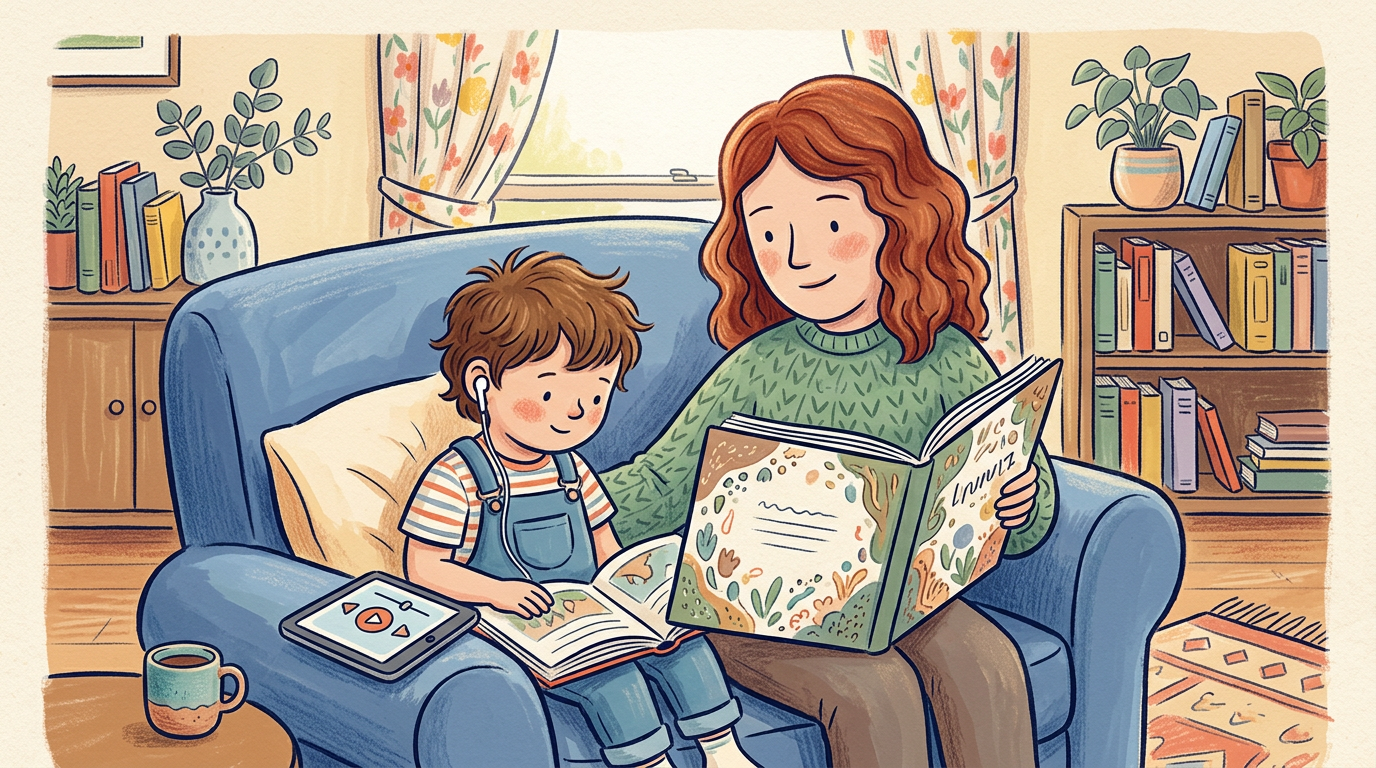
Short answer: no, listening to an audiobook is not cheating — but it's also not a substitute for learning to decode print. Audiobooks and reading instruction do different jobs. Audiobooks build vocabulary, story sense and a love of books; phonics and decoding practice build the mechanical skill of turning letters into sounds. A confident reader eventually needs both, and the research is fairly consistent on how they fit together.
If your child is listening to audiobooks in the car, at bedtime, or through an app like StoryNest, you're not short-circuiting their reading development — as long as it sits alongside regular decoding practice, not instead of it. This article unpacks what the evidence actually shows, where the real caveats are, and how to combine listening and print reading in a way that genuinely helps.
TL;DR
- Reading comprehension depends on two separate skills — word recognition (decoding) and language comprehension. Audiobooks support the comprehension side, not the decoding side (Queensland Department of Education).
- A large meta-analysis found comprehension from listening and reading was broadly comparable, though the gap can be larger in English than in more phonetically regular languages (Clinton-Lisell, via Springer).
- Audiobooks are not an automatic vocabulary equaliser — one 2026 study found lower-SES students didn't show the same gains as higher-SES peers from audiobooks alone, and all students benefited more when listening was paired with adult scaffolding (McGovern Institute/phys.org).
- Talking about the story while or after listening (co-engagement) consistently beats passive solo listening for comprehension and vocabulary growth.
- Decoding still needs explicit, direct teaching — audiobooks don't provide grapheme-phoneme practice, so they should never replace phonics instruction or decodable-text practice (AERO).
- A child with persistent reading difficulty is best discussed with their teacher or a speech pathologist — audiobooks are a genuinely useful tool, but they're not a diagnostic or intervention service.
The two halves of reading: why this question even comes up
It helps to understand why "is listening real reading?" is actually two different questions wearing one hat. Australian education authorities, including Queensland's Department of Education, describe reading comprehension through the Simple View of Reading: comprehension is the product of word recognition (can the child decode the words on the page?) and language comprehension (do they understand what those words mean, strung together, as if spoken aloud?) (Queensland DoE).
If either side is weak, overall reading comprehension suffers — even a child who can decode every word fluently won't understand a text if the vocabulary or sentence structures are beyond them, and a child with a rich vocabulary still can't read a book they can't decode.
Audiobooks sit almost entirely on the language comprehension side of that equation. They remove the barrier of decoding altogether, so a child can access stories, vocabulary and sentence structures well above their current print-reading level (ERIC: Audiobooks and Literacy). This is genuinely useful — but it also explains the limit: listening alone does nothing to build the decoding skill itself.
What the evidence actually says about audiobooks and comprehension
A widely cited meta-analysis comparing reading text versus listening to the same text found no significant overall difference in comprehension outcomes between the two formats (Clinton-Lisell, via Springer; summary via Tech & Learning). In other words, when a child listens to a story well above their decoding level, they can still understand and absorb it roughly as well as if they'd read it themselves.
There's an important caveat for English-speaking families, though. The same analysis found that reading and listening were more similar in languages with transparent spelling systems (where letters reliably map to sounds) than in languages with opaque orthographies, like English, where spelling and pronunciation are often inconsistent. This doesn't mean audiobooks don't work for English-speaking kids — it means we shouldn't assume the research finding transfers perfectly, and it's a reminder that decoding practice in English specifically needs dedicated attention, because English spelling doesn't give young readers many shortcuts.
A further systematic review added useful nuance by age and reader profile: audiobooks alone tended to help comprehension more for younger children, while for struggling readers and children learning English as an additional language, combining audiobooks with the printed text produced bigger comprehension gains than print alone (Audiobooks, Print and Comprehension). This is the evidence base behind the practical method further down this article.
Vocabulary gains are real — but not automatic or equal for everyone
One of the clearest, most repeated benefits of audiobooks is vocabulary exposure. Spoken stories, especially well-written narrative fiction, contain words and sentence structures that simply don't come up much in everyday conversation (EdSurge). As Australian literacy academic Dr Misty Adoniou put it in an ABC News feature on children's audiobooks, vocabulary size is "the best indicator of success at school; not just in reading, in every curriculum area" (ABC News). Adoniou also points out that audiobooks let children access harder, richer books than they could decode independently — rather than limiting them to only what's within their current print ability.
But a 2026 study from MIT's McGovern Institute, published in Developmental Science, adds an important and honest caveat. Children genuinely picked up new vocabulary from audiobooks — but they learned significantly more when listening was paired with explicit, one-on-one adult support, particularly if they were already finding reading difficult (phys.org summary; full study). More strikingly, after accounting for children's starting reading level, higher-SES students showed significant vocabulary gains from audiobooks, while lower-SES students in the same study did not show significant benefits from audiobook listening alone — even with scaffolding.
This is a genuinely important finding to sit with rather than gloss over. It suggests audiobooks are not a neutral, automatically equalising tool — background knowledge, prior vocabulary and the amount of adult support a child gets around the listening experience all seem to shape how much benefit they actually get. It's a strong argument for treating audiobooks as a shared, supported activity rather than something to hand a child and walk away from — particularly for children who are already behind or who have less vocabulary scaffolding at home.
Why co-listening and talking about the story matters
Across several studies, the pattern is consistent: engaged, shared listening beats passive solo listening.
One study comparing 4- and 5-year-olds across three formats — an e-book with audio narration, a silent e-book, and a parent reading aloud — found children recalled far more story detail with audio narration than without it, but their comprehension was best of all when a parent read the story with them directly.
Similarly, a study of Year 3 and 4 students found that children who got periodic one-on-one "scaffolding" check-ins during audiobook listening — brief chats about what was happening, what a word meant, what they thought would happen next — learned significantly more new vocabulary than children who just listened straight through (Remote Text-Supplemented Audiobook Intervention, PMC).
The takeaway isn't that solo listening is worthless — plenty of genuine benefit comes from enjoyable, unscaffolded listening time, and that's a perfectly reasonable use of a commute or a quiet afternoon. But if you have the time and inclination, a few minutes of chat before, during or after an audiobook session appears to meaningfully boost what sticks.
Why decoding still needs its own, separate practice
This is the part that genuinely can't be skipped, and it's worth being direct about it: audiobooks do not teach a child to decode. Decoding — the skill of matching letters and letter patterns to sounds — is built through explicit, systematic phonics instruction and deliberate practice reading print, not through incidental exposure to spoken language (AERO: Introduction to the Science of Reading).
Australian guidance is clear that early readers should be encouraged to sound out words using their phonics knowledge, rather than leaning on pictures or guessing from context, and that decodable texts exist specifically to give children deliberate practice applying the phonics they've been taught. None of that happens through listening alone, no matter how rich or well-narrated the audiobook is.
This is precisely why UK literacy researcher Emily Best, of the National Literacy Trust, is careful to frame audiobooks as a complement rather than a replacement: audiobooks are "a way in to reading print books" that build comprehension and vocabulary, but they "should never replace reading" (ABC News). Using an audiobook is not cheating — but swapping out a child's daily decoding practice for audiobook listening would genuinely slow their progress toward independent print reading.
A practical worked example: "Listen, Then Look"
Here's one simple way families use audio and print together, based on the research above showing that combining audiobooks with the printed text gives struggling and developing readers a bigger comprehension boost than print alone.
The routine:
- Listen for enjoyment. During the school-run commute or a quiet after-school slot, your child listens to a chapter of an audiobook purely for pleasure — no pressure, no follow-up questions, just enjoying the story and absorbing new vocabulary and sentence structures.
- Read the same book, together, in print. On a separate evening, read the next chapter of the same book together in print. Pause occasionally to ask open questions like "what do you reckon that word means?" or "why do you think she did that?"
- Let your child do the decoding. During the print session, resist jumping in with the word immediately — give them a moment to sound it out using their phonics knowledge first, then help if they're stuck.
- Keep it short and low-stakes. Ten to fifteen minutes per session is plenty. The goal is enjoyment and connection, not a test.
This mirrors a sensible classroom approach too. Some Year 3 teachers use audiobooks during science or HASS time to build background knowledge and vocabulary at the class's full comprehension level, while keeping decodable-text practice strictly inside the dedicated phonics block — so audio exposure never substitutes for the systematic, word-level instruction children need at this stage.
A simple checklist: is our audiobook use striking the right balance?
- ✅ My child still does daily (or near-daily) decoding/phonics practice with print, separate from audiobook time
- ✅ We sometimes talk about what we've listened to, rather than only listening passively
- ✅ We occasionally pair an audiobook with its matching print book, especially for trickier texts
- ✅ Audiobook time is framed as enjoyable, not as "extra reading homework" or a replacement for it
- ✅ If my child is well behind peers in decoding, I've raised it with their teacher rather than assuming audio will close the gap alone
If most of these are ticked, audiobooks are very likely doing what the evidence suggests they do best: building vocabulary, comprehension and a love of stories, while decoding is being built elsewhere through proper instruction.
Questions parents and teachers ask
Is listening to an audiobook "cheating" compared to reading the print book?
No. Listening and reading draw on different but overlapping skills, and audiobooks genuinely build comprehension, vocabulary and exposure to story structure — things that matter for reading success just as much as decoding does. The only caveat is that audiobooks shouldn't replace a child's print-reading and phonics practice; used alongside it, listening is a legitimate and valuable form of literacy engagement, not a shortcut around "real" reading (ABC News).
Will audiobooks stop my child learning to sound out words?
Audiobooks won't teach decoding, but they also won't undo it, as long as your child is still getting regular, explicit phonics instruction and print-reading practice separately. Decoding is built through direct instruction and deliberate practice matching letters to sounds — something audio simply doesn't provide either way (AERO). Think of audiobooks as additive to a reading diet, not a replacement for any part of it.
My child has reading difficulties — can audiobooks help, or should we see a specialist?
Both, potentially. Audiobooks can help a child who's struggling with decoding still access age-appropriate stories, build vocabulary and stay engaged with books rather than feeling defeated by them — research suggests struggling readers benefit particularly when audiobooks are paired with the matching print text. But audiobooks aren't a diagnostic tool or an intervention for underlying reading difficulty. If your child's decoding is persistently behind their peers, it's worth raising with their classroom teacher, and a speech pathologist can assess and support specific reading or language difficulties if needed.
Should my child follow along with the text while listening, or just listen?
Either is fine, and it can depend on the goal. Listening without the text is great for pure comprehension, vocabulary and enjoyment, particularly for stories above a child's decoding level. Following along in the print copy while listening (sometimes called "read-along" or text-supported listening) adds a decoding-practice element, since the child sees the words as they hear them — this tends to help struggling readers and those learning English as an additional language most.
At what age should I stop reading aloud and let them use audiobooks instead?
There isn't a cut-off age, and it doesn't need to be either/or. Shared reading aloud with a parent remains one of the most powerful things you can do for a child's comprehension — one study found children's comprehension was highest when a parent read with them directly, even compared to audio narration. Audiobooks are a wonderful addition for commutes, chores, or independent quiet time, but they complement rather than replace parent read-aloud time, at any age.
Can audiobooks help an EAL/bilingual child build English skills?
Yes, with the right pairing. Evidence suggests audiobooks combined with the printed text give bigger comprehension benefits for children learning English as an additional language than print alone, because hearing correct pronunciation, pacing and intonation alongside the text supports both vocabulary and decoding development at once. As with all children, talking about the story together adds further benefit.
How much audiobook time is reasonable per day?
There's no official daily limit in the Australian evidence base, so this comes down to balance rather than a hard number. A reasonable approach is to make sure audiobook listening sits alongside — not instead of — daily print-reading practice, phonics work (for children still building decoding), and ordinary family read-aloud time, rather than treating any single format as "enough" on its own.
If you're looking for audiobooks that work well alongside your child's reading development — including family-recorded stories that add a personal, familiar voice to listening time — you can browse more ideas at StoryNest's resources hub, see what StoryNest offers at storynest.com.au, explore classroom-friendly options via StoryNest for Schools, or create a free account to get started.
Sources
- Queensland Department of Education — Reading Position Statement
- AERO — Introduction to the Science of Reading
- Audiobooks, Print, and Comprehension: What We Know and What We Don't (Springer)
- Listen Without Guilt: Audiobooks Offer Similar Comprehension As Reading — Tech & Learning
- Breaking Barriers to Literacy: Using Audiobooks to Overcome Reading Challenges — EdSurge
- Audiobooks and Literacy — ERIC
- Audiobooks can help students learn new words—especially when paired with instruction — phys.org
- Remote Text-Supplemented Audiobook Intervention Supports Children's Vocabulary — Wiley/Developmental Science
- Remote Text-Supplemented Audiobook Intervention — PMC
- Children's audiobooks are growing in popularity. How useful are they? — ABC News
Keep the next story going.
All resources